










Introduction
A guardrail plays a fundamental role in securing areas that present a risk of falling, while also contributing to the architectural coherence of a building. Its performance relies on the precise interaction of several components, each with a specific function related to strength, stability, and ergonomics.
Understanding the essential elements that make up a guardrail makes it easier to assess the quality of a design, its compliance with standards, and its long-term durability. This understanding is essential for residential, commercial, or industrial projects where safety cannot be separated from technical reliability.
Summary of Key Points
| Component | Main Function | Impact on Safety and Durability |
| Posts | Load-bearing vertical structure | Overall stability of the guardrail |
| Handrail | User support and guidance | Safety and ergonomics |
| Infill elements | Protection against passage or falls | Compliance and continuous protection |
| Supports and fasteners | Anchoring to the structure | Long-term reliability |
| Materials | Mechanical and environmental resistance | Longevity and maintenance |
| Custom fabrication | Adaptation to project constraints | Precision and compliance |
| Finishes | Surface protection | Resistance to wear and corrosion |
Understanding the Overall Function of a Secure Guardrail
The primary function of a guardrail is to prevent falls in elevated areas or where there is a change in level. This function requires the ability to withstand loads applied by users, horizontal forces, and repeated stresses associated with daily use. The performance of a guardrail therefore does not depend on a single element, but on the coherence and quality of all its components.
Each element, whether structural parts, protective elements, or fastening systems, contributes to the overall stability of the system. A rigorous design ensures balanced load distribution and avoids weak points that could compromise safety. This holistic approach is essential to meet regulatory requirements and ensure long-lasting protection.
Posts: The Structural Framework of the Guardrail
Role of Posts in Stability
Posts form the vertical framework of the guardrail. They transfer loads to the supporting structure and ensure overall rigidity. Their positioning, cross-section, and method of attachment directly influence the guardrail’s ability to withstand required loads.
Proper spacing between posts helps limit deflection and ensures structural continuity. This layout must be considered during the design phase to optimize mechanical strength while respecting the project’s aesthetic constraints.
Material Selection for Posts
The material used for posts is a determining factor in the guardrail’s durability.
- Steel offers excellent mechanical strength and is suitable for applications requiring high rigidity.
- Stainless steel is preferred in humid or exposed environments due to its increased resistance to corrosion.
- Aluminum, being lighter, is well suited when weight constraints are significant, while still offering good long-term performance.
Material selection must always take into account the installation environment, the height of the guardrail, and applicable regulatory requirements.
Infill Elements: Protection and Compliance
Function of Infill Elements
Infill elements are designed to prevent passage or falls between posts. They provide continuous protection along the full height of the guardrail and contribute to user safety, particularly in public areas or spaces frequented by children.
Depending on the project, infill can take different forms:
- solid panels,
- vertical or horizontal balusters,
- tensioned cables,
- perforated panels.
Each configuration addresses specific requirements related to safety, visibility, and architectural integration.
Regulatory Constraints
Standards impose precise requirements regarding the spacing of infill elements, minimum height, and resistance to loads. Compliance with these criteria is essential to ensure the guardrail meets regulations and to avoid any unsafe use.
Custom design makes it possible to precisely adjust the dimensions and layout of infill elements to meet these requirements while integrating harmoniously with the building’s architecture.
The Handrail: Ergonomics and User Safety
Functional Role of the Handrail
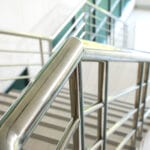
The handrail is the primary point of contact between the user and the guardrail. It provides continuous, secure support, facilitating movement and reinforcing a sense of stability. Its presence is particularly important on stairs, ramps, and extended circulation areas.
A well-designed handrail improves the ergonomics of the guardrail and helps prevent loss of balance, especially in high-traffic areas.
Design Criteria
The handrail’s profile, height, and continuity must be adapted to its intended use. A smooth, uniform surface without protrusions promotes a comfortable grip and reduces snagging risks. Material choice and surface treatment also influence durability and ease of maintenance.
Compliance with accessibility standards is a central aspect of design to ensure safe use for all users.
Supports and Fasteners: A Key Factor in Reliability
Importance of Fastening Systems
Supports and fasteners anchor the guardrail to the existing structure. Their role is often underestimated, yet they directly determine the stability and durability of the installation. Inadequate fastening can compromise the effectiveness of the entire system, even if other components are of high quality.
Fastening systems must be selected based on the anchoring substrate, whether concrete, steel, or a mixed structure.
Adaptation to Site Constraints
Each construction site presents specific constraints. Base plates, anchors, and fastening systems must be sized to withstand anticipated loads and environmental conditions. Proper design also facilitates on-site installation and minimizes unexpected adjustments during assembly.
Materials and Surface Treatments
Durability and Environmental Resistance
Material selection alone is not sufficient to guarantee the longevity of a guardrail. Surface treatments play a critical role in protection against corrosion, wear, and climatic exposure. Galvanizing, powder coating, or specific finishes allow the guardrail to be adapted to its environment.
These treatments also help preserve the aesthetic appearance of the guardrail over time while reducing maintenance requirements.
Consistency Between Material and Use
Each material reacts differently to mechanical and environmental stresses. Consistency between the chosen material, the applied treatment, and the intended use is essential to ensure long-term guardrail performance.
Custom Fabrication and Precision Execution
Custom fabrication makes it possible to adapt each component to the exact dimensions of the project and to site-specific constraints. Precision manufacturing processes, such as laser cutting, provide consistent parts and high assembly quality.
This precision simplifies installation, improves dimensional compliance, and contributes to the overall reliability of the guardrail, particularly in complex architectural projects.
Standards and Regulatory Requirements Applicable to Guardrails
Guardrail design is governed by strict regulatory requirements intended to ensure user safety. These requirements directly influence component height, strength, and layout.
Key regulatory parameters to consider include:
- minimum guardrail height depending on the protected area,
- resistance to horizontal and vertical loads,
- maximum spacing of infill elements,
- continuity and graspability of the handrail,
- the ability of fasteners to transfer loads to the supporting structure.
Integrating these criteria from the design phase helps avoid later adjustments and ensures lasting compliance of the installation.
Interaction Between Components and In-Service Behavior
A high-performance guardrail relies on the balance between its various components once assembled. Applied loads are transmitted progressively:
- from the handrail to the posts,
- from the posts to the supports and fasteners,
- from the fasteners to the supporting structure.
This load transfer chain must be uniform to avoid stress concentrations. Custom design allows each element to be adapted to ensure balanced mechanical behavior and long-term resistance to repeated loads.
Environmental Factors to Consider When Selecting Components
The installation environment has a strong influence on guardrail performance. Several factors must be analyzed:
- exposure to moisture or water splash,
- presence of corrosive agents or pollutants,
- temperature variations and freeze-thaw cycles,
- traffic intensity and impact risks.
Anticipating these constraints helps guide the selection of materials and surface treatments toward suitable solutions, limiting premature wear and maintenance needs.
Summary Table: Role and Constraints of Components
| Component | Key Function | Main Constraints |
| Posts | Load transfer | Spacing, rigidity, anchoring |
| Infill elements | Continuous protection | Regulatory spacing |
| Handrail | Support and guidance | Ergonomics, continuity |
| Supports and fasteners | Structural connection | Support type, loads |
| Materials | Overall strength | Corrosion, environment |
| Surface treatments | Protection and durability | Exposure, wear |
Best Design Practices for Durable Guardrails
To ensure long-term guardrail performance, several best practices can be incorporated at the design stage:
- anticipate regulatory constraints,
- ensure consistency between materials and environment,
- size fasteners according to actual loads,
- guarantee functional continuity of components,
- facilitate inspection and maintenance.
These principles strengthen the overall reliability of the guardrail and contribute to safe long-term use.
A Professional Design Approach
The performance of a guardrail is based on a comprehensive approach that integrates design, fabrication, and an understanding of standards. Technical expertise makes it possible to anticipate usage constraints, select appropriate components, and ensure coherence between safety, durability, and aesthetics.
At Métanox, guardrail design is supported by in-depth expertise in metal fabrication and a constant focus on the quality of each component, from structure to finishes.
Conclusion
A secure guardrail relies on the precise balance between its various components: posts, infill elements, handrail, supports, and fasteners. Each plays an essential role in the stability, safety, and durability of the overall system. Rigorous design, combined with careful selection of materials and surface treatments, makes it possible to meet regulatory requirements while integrating harmoniously with the building’s architecture.
By prioritizing precision fabrication and a coherent technical approach, it is possible to design reliable, durable guardrails adapted to contemporary uses, fully meeting expectations for safety and performance.