




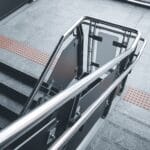
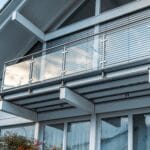

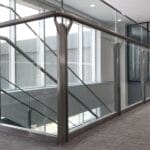

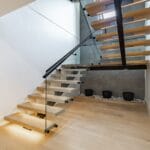
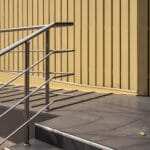
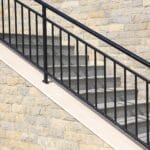

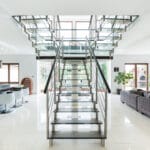

Designing a staircase, balcony, or platform is not limited to choosing a style or material. The safety components that accompany these structures, particularly guardrails and handrails, play an essential role in protecting users and ensuring regulatory compliance. However, these two elements are often confused, even though they serve distinct functions and are subject to different technical requirements. Understanding their specific roles makes it possible to design a cohesive, safe, and durable system that aligns with both the architecture and the actual needs of the project.
This guide provides a detailed analysis of the differences between guardrails and handrails, their respective uses, applicable standards, and selection criteria based on the environment and chosen materials. It is intended for homeowners, architects, property managers, and anyone involved in the design or renovation of structures requiring protective systems.
Distinct Roles of Guardrails and Handrails
1. The Guardrail: Protection Against Falls
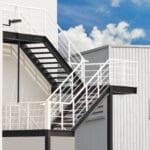
A guardrail is a safety device installed along the edges of staircases, terraces, mezzanines, accessible roofs, docks, or platforms. Its primary function is to prevent accidental falls. It forms a physical barrier that must meet strict requirements for height, mechanical strength, and spacing between components.
Main Functions
- Prevent people or objects from falling.
- Define safe areas and exposed zones.
- Contribute to the visual stability of the space.
- Provide support for elements such as glass panels or decorative infills.
Essential Characteristics
- Self-supporting or fixed structure.
- Regulatory height depending on use and location.
- High mechanical strength.
- Ability to integrate a handrail on top.
2. The Handrail: Continuous Support During Movement
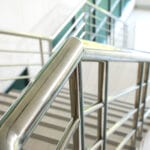
The handrail, often referred to as a railing, is a linear element installed along a staircase or access ramp. Its function is to provide continuous hand support to stabilize movement.
Main Functions
- Facilitate ascending and descending.
- Improve grip and user safety.
- Contribute to building accessibility.
Essential Characteristics
- Positioned at an ergonomic height.
- Shape and diameter suitable for gripping.
- Continuous, with no sharp edges or unjustified interruptions.
Comparison Table: Guardrail vs Handrail
| Criterion | Guardrail | Handrail |
| Function | Prevents falls | Provides support for movement |
| Location | Edges of stairs, balconies, platforms | Along staircases or ramps |
| Height | Defined by safety standards | Ergonomic hand height |
| Structure | Complete load-bearing element | Complementary linear element |
| Materials | Stainless steel, steel, aluminum, glass-metal | Stainless steel, steel, aluminum, wood, or metal |
| Strength | High, structural | Lower but consistent |
| Maintenance | Depends on material and environment | Generally minimal |
Standards and Requirements: Two Separately Regulated Systems
Although guardrails and handrails are often associated, they are governed by distinct standards. Compliance ensures user safety and seamless integration into the structure.
Standards Applicable to Guardrails
Main Criteria
- Minimum height based on location and use.
- Resistance to horizontal and vertical loads.
- Spacing between balusters, cables, or panels.
- Anchoring compatible with the supporting structure.
A guardrail must withstand significant forces, particularly in cases of accidental impact or crowd pressure. It is a structural element that involves the responsibility of both the designer and the manufacturer.
Standards Applicable to Handrails
Main Criteria
- Height suited to hand grip.
- Continuous shape without unjustified interruptions.
- Minimum clearance from walls to allow proper gripping.
- Extensions at the top and bottom of stairs depending on use.
A handrail should remain simple and intuitive, offering natural guidance to users.
Suitable Materials for Guardrails and Handrails
Material selection influences rigidity, aesthetics, durability, and maintenance. The three most common material families are stainless steel, protected carbon steel, and aluminum. Combinations with glass are also frequently used to enhance light transmission.
Stainless Steel
Stainless steel is one of the most widely used materials for guardrails and handrails. It offers excellent corrosion resistance thanks to the natural passive layer that forms on its surface. Its high rigidity makes it a reliable choice for structures exposed to significant loads.
Advantages
- Excellent performance in outdoor environments.
- High mechanical strength.
- Wide range of finishes: brushed, polished, satin.
Protected Steel
Carbon steel provides excellent rigidity and allows for a wide range of shapes. To resist corrosion, it must receive appropriate treatment, such as surface preparation followed by protective coating.
Advantages
- Strong and versatile.
- Wide range of design possibilities.
- Suitable for interior or protected exterior projects.
Aluminum
Lightweight and naturally resistant to oxidation, aluminum is often selected for environments where handling and installation need to be simplified. However, it must be carefully engineered, as its rigidity is lower than that of steel.
Advantages
- Reduced weight.
- Wide range of colors when powder-coated.
- Good outdoor durability.
Design and Integration: A Cohesive and Safe System
The effectiveness of a guardrail or handrail depends largely on design quality. A preliminary assessment of usage, circulation patterns, and the supporting structure allows for proper sizing of sections, fixings, and heights.
1. Analysis of Use and Circulation
- Determine traffic intensity.
- Identify risk zones.
- Anticipate accessibility needs.
2. Structural Sizing
A guardrail must be designed as a load-bearing element. Horizontal and vertical forces influence:
- tube or post thickness,
- the type of anchoring,
- the potential use of glass or metal infill panels.
3. Handrail Positioning
The handrail must follow natural movement. Its integration may be:
- independent on the wall,
- integrated into the guardrail,
- doubled in high-traffic areas.
Aesthetics and Finishes: Visual Cohesion of the Project
Beyond their safety function, guardrails and handrails influence the perception of space. Their finish contributes to the overall harmony of the project.
Brushed Stainless Steel
Clean appearance and durability.
Polished Stainless Steel
Enhanced brightness.
Powder-Coated Aluminum
Wide color range and visual consistency.
Glass and Metal
Transparency and emphasis on clean lines.
Summary Table: Selection Criteria
| Criterion | Importance | Guardrail | Handrail |
| Safety | Essential | Very high | High |
| Mechanical strength | High | Critical | Moderate |
| Aesthetics | Variable | Modular | Discreet |
| Maintenance | Regular | Depends on material | Minimal |
| Durability | High | Depends on finishes | Very good |
Fabrication and Installation: Defining Quality Factors
Precision cutting, weld quality, deburring, and finishing directly affect durability. Proper installation, including torque control and anchorage compatibility, ensures long-term system stability.
Métanox can assist at this stage to ensure fabrication meets standards, with consistent finishes adapted to the intended use.
Conclusion
The difference between guardrails and handrails lies in their roles, requirements, and integration into the structure. Guardrails protect against falls, while handrails provide continuous support during movement. The right choice depends on usage, materials, site constraints, and applicable standards. Precise design combined with high-quality fabrication ensures durability and safety. Métanox teams can support these steps to deliver reliable, well-integrated, and purpose-built systems.